

Children’s Vision & Learning Month
August is globally-recognized as Children’s Vision and Learning Month – A back-to-school goal of bringing awareness to parents and educators about the critical link between vision and learning. VisionandLearning.org tells us the visual system is responsible for 75-90% of all learning in the classroom. However, “25% of students in grades K-6 have visual problems serious enough to impede learning,” according to the American Public Health Association.
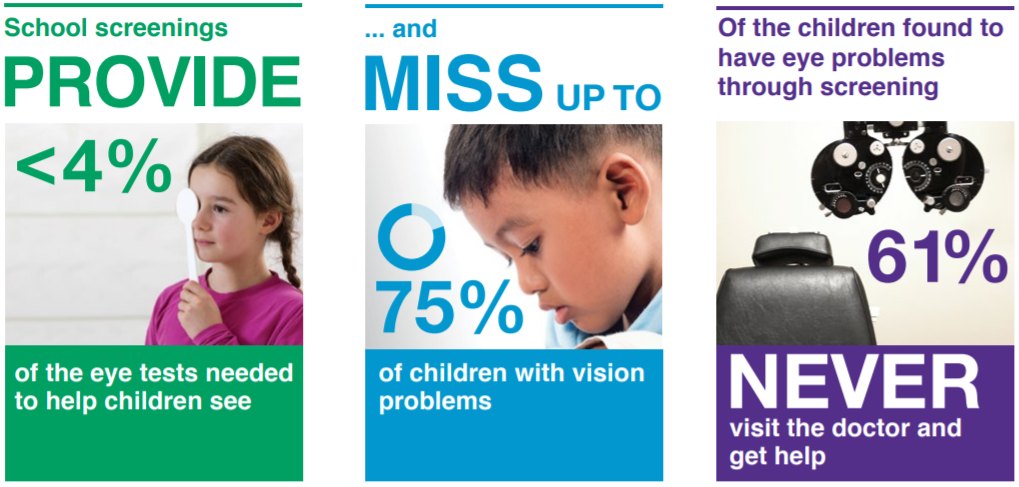
Despite these staggering numbers, many students go to school year after year without ever having their vision problems recognized, diagnosed, or treated. Falling short of expectations will be attributed to laziness, other interests, a short attention span, a poor attitude towards school, or any other suitable explanation that can be grasped. This is primarily due to the mistaken old-fashioned belief that an eye chart exam or school vision screening is an adequate vision evaluation.
In fact, an estimated 80-85% of children with learning complications actually have undiagnosed vision problems.
When children struggle with schoolwork, reading fluency, comprehension, and attention span, it is often due to eye coordination and eye movement disorders. Vision screenings and eye chart exams are not designed to reveal these problems. They assess distance vision only – 20 feet blackboard range – hence 20/20. They do not evaluate the near vision needed for reading or close work such as homework.
When these near vision issues are left undetected, learning is impacted, which can lead to lower grades, behavioral problems and quite frequently a misdiagnosis of ADHD. This is because many vision disorders cause the same symptoms doctors label as ADHD.
Symptoms which may indicate a vision problem that can affect learning include:
- Fatigue, headaches, blurry or itchy eyes
- Poor comprehension and/or memory, forgetful
- Short attention span, fidgety
- Loses place while reading
- Clumsy, poor hand-eye coordination
- Sloppy handwriting, reverses letters
- Poor at spelling or math
- Dislike’s school, avoids reading, takes a long time with homework
- Learns better orally than visually
There are 17 visual skills needed for the near (reading) vision that is imperative for learning. These include focusing, eye tracking, eye coordination and visual perception. To properly assess all these skills, your child needs a developmental vision evaluation by a professional such as a developmental optometrist.
If you schedule an appointment with us, we will give your child a thorough evaluation of both near and far vision. If any deficiencies are found, we will recommend options to improve your child’s vision and subsequently learning capabilities. Treatments such as vision therapy and light therapy are being used with great success worldwide. Vision therapy is a program of exercises designed to train the eyes and brain to work together at optimum capacity. Light therapy supplements that by relaxing the eyes enough to train them better. These programs are tailored specifically to your child’s vision diagnosis.
Whether you have noticed your child with any of the above symptoms or learning struggles, it is best to have him or her evaluated comprehensively for the upcoming school year. Children frequently do not realize there is anything wrong with their vision if they have become accustomed to it. The outdated vision screenings are inadequate now, as optometric, and medical research is continuing to prove the connection between vision problems and academic performance.
Before another school year starts, give us a call to schedule a developmental vision evaluation for your child.
Together, let’s make this school year a success!
Quick Links
All Eye
Care Services
Keep
In Touch